Can Damaged Lead Flashing Be Repaired, or Does It Need Replaced?
Understand when a local lead flashing repair is sensible, when replacement is needed and why the surrounding roof junction matters.
Home›Advice›Can Damaged Lead Flashing Be Repaired, or Does It Need Replaced?
Roof repairs
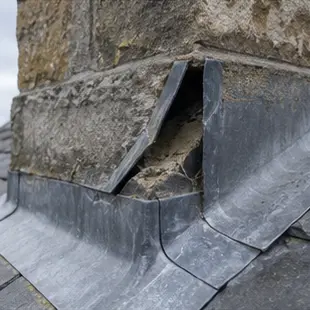
Illustrative image: inspect the complete junction before choosing a repair.
The short answer
Some local defects can be repaired when the surrounding lead and roof junction remain sound. Widespread splitting, repeated failed patches or a poorly formed junction can make replacement more sensible. The decision should follow the water path and the condition of the whole detail, not just the visible crack.
Start with what you can see from inside the property, ground level or a safe window. Do not climb onto the roof, lean out of a window or walk on a fragile covering. These steps give a roofer useful context without putting you at risk.
Note when the leak appears and which room is affected.
Photograph accessible indoor staining and the roof junction from the ground.
Keep details of earlier sealant or flashing repairs.
Avoid lifting, bending or attempting to patch lead yourself.
Identify the part that has actually failed
Flashing is the weathering that protects a join, such as where a roof meets a chimney or wall. The visible lead may be only one part of the assembly. The fault might be an opening at its top edge, a split in the sheet, a poorly covered joint or a defect in the surrounding masonry.
Ask for a close photograph with the suspected entry point identified. A quote that simply says “seal leadwork” leaves too much unclear. You should know whether the proposed work repairs lead, renews its fixing or addresses another part of the roof junction.
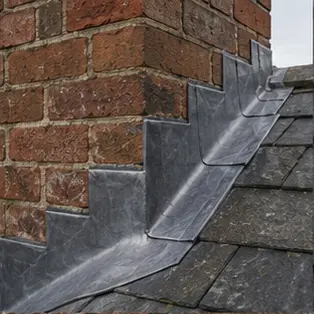
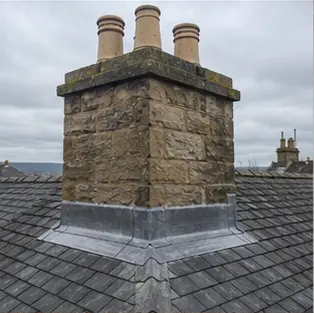
Illustrative image: the repaired detail must connect correctly to the roof and wall.
When a limited repair may be appropriate
A small, accessible defect in otherwise serviceable material may justify a local repair. The surrounding sheet must be suitable to receive it, and the method must match the location and water flow. SPAB describes both local repairs and short replacement sections as possible approaches to damaged metal flashing.
Ask why the proposed repair is expected to last and whether it is temporary or intended as the finished solution. A local repair is easier to assess when the contractor can explain the existing material’s condition and show how the repaired detail will continue to shed water.
When replacing the affected detail is more sensible
Several splits, distortion, numerous overlapping patches or a junction that has repeatedly leaked are reasons to discuss replacement of the affected assembly. That does not automatically mean replacing all lead on the building. The scope should follow the evidence and identify which sections can remain.
Ask whether the original arrangement contributed to failure. Renewing material in exactly the same defective arrangement may repeat the problem. The contractor should specify the replacement detail, its connections to neighbouring roof coverings and how movement and drainage will be accommodated, rather than relying on a thicker layer of surface sealant.
Include concealed layers and surrounding materials
Water can get behind sound-looking lead through damaged masonry or roofing above it. Soakers beneath adjoining slates, a back gutter behind a chimney and roof-to-wall joins may need inspection as part of tracing the leak. Access limitations should be stated before a firm diagnosis is claimed.
If roof coverings must be lifted, agree how they will be reinstated and what happens if broken pieces or damaged supporting layers are found. This makes two quotations easier to compare: one may include opening the junction and rebuilding it, while another only treats its visible surface.
Keep a clear record of the completed repair
The final description should identify the location, materials renewed, adjoining work and exclusions. Ask for photographs before coverings conceal the important connections, where practical. If a repair is temporary, keep the follow-up recommendation and intended timescale with the invoice.
For an active leak, also agree what to watch indoors after the work. Existing moisture can take time to dry, so the next inspection should distinguish drying marks from fresh water entry. Returning photographs taken from the same position can make that discussion more useful than saying only that the ceiling still looks stained.
Preparing for an inspection
Send the property postcode, a safe ground-level photograph and the history of the problem or planned work. Mention access restrictions, previous repairs and any shared parts of the building. Ask what can be established during the visit and what may remain uncertain until work begins.
Questions worth asking before you approve work
Is the defect in the lead or its surrounding junction?
Is this temporary or permanent work?
Which concealed components will be inspected?
What will be reinstated after access?
You should understand the recommended repair, how the roof will be reached and anything the quote does not include. Do not choose on price alone when two quotes cover different work.
Discuss your property with OnPoint RoofCare
For roofing enquiries in Motherwell, Lanarkshire, Glasgow and the surrounding service area, call with your postcode and a brief description of the work. We can discuss the appropriate next step and any further inspection or specialist input needed before a scope is agreed.
Talk to us about lead flashing repairs and replacement
Send the property area and a safe ground-level photograph if you have one. We will review what you have noticed and contact you about the appropriate next step.