Why Do Gutters Still Overflow After They Have Been Cleaned?
Find out why clean gutters can still overflow, from blocked downpipes and poor alignment to outlet restrictions and concentrated roof runoff.
Home›Advice›Why Do Gutters Still Overflow After They Have Been Cleaned?
Roof problems
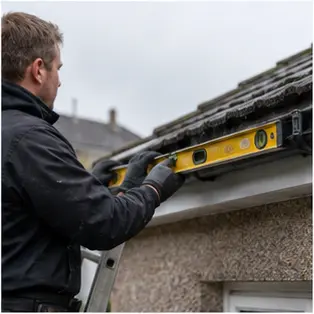
Illustrative image: record where overflow starts during rainfall.
The short answer
Cleaning the open gutter does not prove that the whole drainage route is clear or correctly arranged. Water can still back up because of a blocked outlet or downpipe, a low section, poor alignment or insufficient capacity for the flow reaching it. Observe exactly where overflow occurs before choosing the next repair.
Start with what you can see from inside the property, ground level or a safe window. Do not climb onto the roof, lean out of a window or walk on a fragile covering. These steps give a roofer useful context without putting you at risk.
Film the overflow from a sheltered ground-level position.
Note whether one point or the whole run overflows.
Keep the date and scope of the recent cleaning.
Do not climb a ladder during rain to investigate.
Check what the cleaning actually included
A gutter clear-out may remove visible leaves without checking the outlet, downpipe or drain at ground level. Ask for the contractor’s record of what was inspected and cleared. If photographs are available, look for the affected outlet rather than assuming a clean-looking length proves the system is clear.
Debris can also return quickly from nearby trees or a roof above. Note the interval between cleaning and renewed overflow. That helps distinguish fresh blockage from an unresolved restriction, and it gives the next contractor something more useful than a general statement that the gutters were recently done.
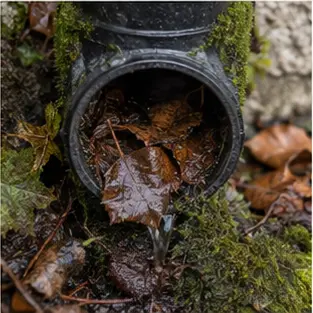
Illustrative image: restrictions may remain beyond the cleaned gutter.
Follow the water beyond the gutter
A restriction at the outlet or within a downpipe can make an otherwise clear gutter back up. Water may escape at a downpipe joint or collect near its base as well. Engine Shed’s rainwater guidance treats gutters and downpipes as a maintenance system; both need attention.
Ask where the pipe discharges and whether the accessible route has been checked. If the issue continues into underground drainage, the appropriate drainage specialist may be needed. Replacing the gutter will not necessarily correct a blockage farther downstream.
Sagging or poorly aligned lengths can collect water away from the outlet. A gutter that sits incorrectly in relation to the roof edge may also fail to catch runoff. From ground level, record where water first escapes; do not try to judge precise falls or adjust brackets yourself.
The inspection should check supports, joints and the relationship to the roof edge. Ask whether realignment is possible with the existing components or whether damaged supports and lengths need replacement. The repair should address the arrangement that caused the overflow, not only seal the place where water appeared.
Consider the amount and concentration of roof runoff
A valley, dormer or altered roof can direct a concentrated stream into one section. Tell the contractor about extensions, changes to neighbouring roof drainage or problems that occur only in intense rain. A photograph showing the roof above the overflow point helps establish that context.
Do not assume that simply fitting a larger gutter is the answer. Outlet position, downpipe capacity, the discharge route and the available space need to be considered together. Ask for the proposed drainage arrangement and the reason it suits the roof area feeding it.
Confirm the improvement and plan maintenance
Ask how the contractor will check the agreed repair and what it cannot establish. A controlled check can help identify leaks and restrictions, but one dry visit cannot recreate every combination of rainfall and wind. Monitor the same point in later rain and keep the original recording for comparison.
If trees or roof debris are a recurring issue, agree a suitable inspection and cleaning plan. Protective accessories should be chosen for the actual system and should not be presented as removing all maintenance. The objective is a clear, correctly arranged route from roof to discharge, with any remaining drainage problem identified.
Preparing for an inspection
Send the property postcode, a safe ground-level photograph and the history of the problem or planned work. Mention access restrictions, previous repairs and any shared parts of the building. Ask what can be established during the visit and what may remain uncertain until work begins.
Questions worth asking before you approve work
Were the outlet and downpipe checked during cleaning?
Does the gutter fall towards the outlet?
Has the roof runoff pattern changed?
How will the repair be checked?
You should understand the recommended repair, how the roof will be reached and anything the quote does not include. Do not choose on price alone when two quotes cover different work.
Discuss your property with OnPoint RoofCare
For roofing enquiries in Motherwell, Lanarkshire, Glasgow and the surrounding service area, call with your postcode and a brief description of the work. We can discuss the appropriate next step and any further inspection or specialist input needed before a scope is agreed.
Talk to us about guttering and roofline repairs
Send the property area and a safe ground-level photograph if you have one. We will review what you have noticed and contact you about the appropriate next step.