Should You Repair Cast Iron Gutters or Replace Them?
Compare cast iron gutter repairs and replacement, including joints, corrosion, brackets, matching sections and traditional Scottish buildings.
Home›Advice›Should You Repair Cast Iron Gutters or Replace Them?
Roof repairs
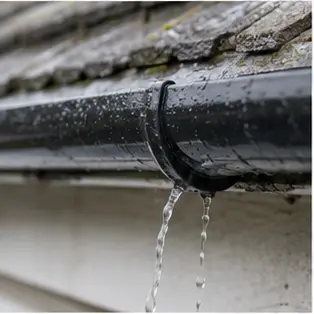
Illustrative image: a joint leak should be distinguished from failure of a whole length; gutter material requires confirmation.
The short answer
Cast iron gutters do not automatically need replacing because paint has failed or a joint leaks. Sound sections may be repairable, while cracked or badly corroded sections and insecure supports need closer assessment. On traditional buildings, matching the profile and retaining appropriate materials can be important parts of the decision.
Start with what you can see from inside the property, ground level or a safe window. Do not climb onto the roof, lean out of a window or walk on a fragile covering. These steps give a roofer useful context without putting you at risk.
Observe the gutters from ground level during rain if safe.
Photograph the leak and the whole gutter run.
Keep clear of loose or displaced sections.
Mention whether the property is listed or has shared rainwater goods.
Distinguish a leaking joint from a failed section
Water dripping from a joint may have a different cause from water escaping through a cracked length. Record where it falls and whether the gutter is also overflowing. Paint condition alone cannot show the remaining condition of the metal underneath.
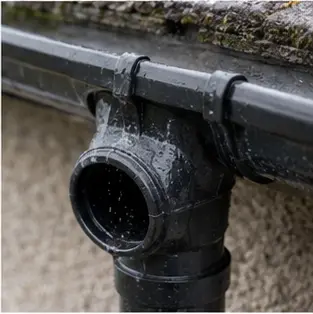
Ask the contractor to identify the material rather than assume all black gutters are cast iron. Similar-looking systems can require different repairs and replacement parts. A meaningful inspection records the joints, gutter lengths, brackets, outlets and downpipes as a connected system.
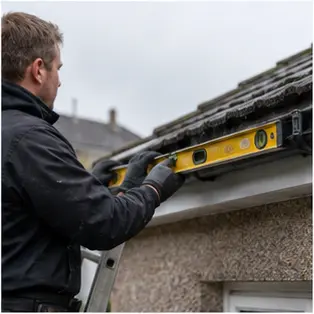
Illustrative image: alignment and supports form part of the inspection, whatever the gutter material.
Retain sound material where a proper repair is feasible
Historic Environment Scotland’s Engine Shed guidance supports maintaining and repairing traditional cast iron rainwater goods where possible. It also explains the importance of suitable protective painting and sound joints. Repair should follow a condition assessment, rather than simply coating over an unexplained leak.
Ask which existing lengths can remain, what preparation is needed and whether an individual joint or matching section can be renewed. The scope should include access to the affected area and the work needed to make the retained system serviceable. Keep a clear distinction between cosmetic painting and correcting a functional defect.
Take fractures, weak supports and repeated defects seriously
A fractured length, extensive metal loss or unreliable fixings may make replacement of the affected part necessary. Cast iron components are heavy, so loose sections above a path or entrance require prompt attention and an exclusion area below until assessed.
Consider the entire run before accepting a series of isolated patches. If several sections and supports are poor, ask for a comparison between staged repair and a more complete renewal. The contractor should show why the proposed boundary is practical and how retained and new sections will connect.
Consider the building’s character and matching profiles
On an older Scottish house, the shape and material of gutters and downpipes can be part of the building’s appearance. Engine Shed cautions against replacing traditional cast iron with inappropriate alternatives. For a listed property, check the proposed change with the council before ordering a different system.
Ask for the profile, size, outlet positions and bracket arrangement to be stated. Where matching parts need sourcing, establish availability before a start date is promised. A sample or product drawing can clarify what will be installed and avoid a decision based on an imprecise description such as “black guttering”.
After repair or replacement, the gutter must still carry water to the outlet and the downpipe must discharge properly. Ask how alignment, joints and downstream blockages will be checked, and whether any inaccessible sections remain outside the inspection.
Keep the product details and any maintenance advice with the invoice. If repairs are staged, record what is still outstanding. A repaired joint is useful only as part of a functioning system; continuing overflow elsewhere can keep wetting the wall even when the original drip has stopped.
Preparing for an inspection
Send the property postcode, a safe ground-level photograph and the history of the problem or planned work. Mention access restrictions, previous repairs and any shared parts of the building. Ask what can be established during the visit and what may remain uncertain until work begins.
Questions worth asking before you approve work
Has the material and profile been confirmed?
Which sections and supports remain sound?
Can suitable matching components be obtained?
Does the quote include downstream drainage checks?
You should understand the recommended repair, how the roof will be reached and anything the quote does not include. Do not choose on price alone when two quotes cover different work.
Discuss your property with OnPoint RoofCare
For roofing enquiries in Motherwell, Lanarkshire, Glasgow and the surrounding service area, call with your postcode and a brief description of the work. We can discuss the appropriate next step and any further inspection or specialist input needed before a scope is agreed.
Talk to us about cast iron gutter repairs and replacement
Send the property area and a safe ground-level photograph if you have one. We will review what you have noticed and contact you about the appropriate next step.