Is Standing Water on a Flat Roof Always a Problem?
Understand the difference between temporary surface water and persistent ponding, which warning signs matter and how drainage should be checked.
Home›Advice›Is Standing Water on a Flat Roof Always a Problem?
Flat roofs
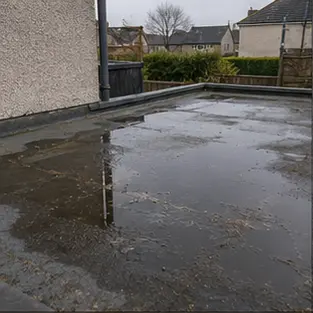
Illustrative image: record whether pools persist after rainfall.
The short answer
Water visible during or just after rain does not by itself prove a flat roof has failed. Persistent pools, blocked outlets, increasing low spots or water close to vulnerable junctions deserve investigation. Judge the drainage pattern and the particular roof system rather than applying one time limit to every roof.
Start with what you can see from inside the property, ground level or a safe window. Do not climb onto the roof, lean out of a window or walk on a fragile covering. These steps give a roofer useful context without putting you at risk.
Record water from a safe window without leaning out.
Photograph the same area after rain and later in dry weather.
Note any indoor leaks or change in the pool’s size.
Do not walk onto the roof or try to puncture a pool to drain it.
Record what happens after the rain stops
A photograph taken during a downpour cannot show whether a roof is draining normally. If there is a safe view, record when the rain stops and whether the same pool remains later. Include a wide photograph showing the outlet and edges, not only a close-up of water.
Avoid using a universal “safe after this many hours” rule. Different systems and roof designs have different requirements, and some specialist roofs are designed to retain water. For an ordinary garage or extension roof, ask the contractor to compare the observed condition with the actual system and drainage design.
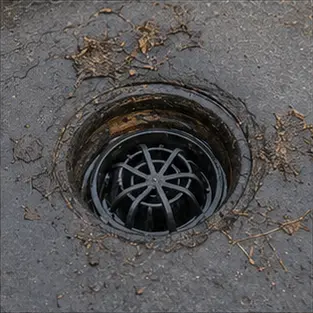
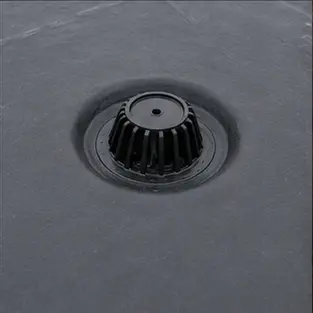
Illustrative image: check the outlet as well as the surface levels.
Distinguish a blocked outlet from a low area
An obstructed outlet can hold water across a larger area; a depression may leave a local pool even when the outlet is clear. Both deserve attention, but they do not call for the same repair. Clearing leaves will not change an inadequate fall, while renewing a covering without checking the outlet can retain the original problem.
NHBC’s best-practice guide highlights effective drainage and suitable overflow arrangements. This is construction guidance, not a diagnosis or a blanket legal rule for every existing roof. The practical inspection question is where the water should go and what prevents it getting there.
A growing depression, new internal damp, water reaching raised junctions or a visibly obstructed overflow makes the situation more urgent. Tell the roofer about changes rather than describing the roof simply as flat. If the ceiling below is bulging or material is moving, keep people away from the affected area.
Do not add boards or weights, cut the membrane or attempt to create a new drain. Those actions can damage the system or change how loads and water are carried. Safe observation gives useful evidence without turning an uncertain drainage issue into a new opening in the roof.
The answer may be maintenance, an outlet repair, correction of a local detail or broader work to the falls and deck. Ask the contractor to distinguish these possibilities and identify the evidence supporting the recommendation. A covering replacement is not automatically a drainage redesign.
If the proposal changes the roof build-up, ask how the new levels affect wall connections, edge heights, rooflights and outlets. These details need to work together. A quote should explain the intended finished water route and which surrounding elements will be renewed or retained.
Agree how drainage will be checked afterwards
Keep photographs of the original pools and the completed work. Ask how the contractor will confirm that the agreed defect has been addressed, without expecting a flat roof to look completely dry at every instant of rainfall.
Plan access for future inspection and cleaning with the contractor; homeowners should not have to walk onto a fragile or unprotected roof. Report recurring debris and nearby vegetation so maintenance can be appropriate to the property. The aim is a roof that drains as intended, with any remaining limitations clearly explained.
Preparing for an inspection
Send the property postcode, a safe ground-level photograph and the history of the problem or planned work. Mention access restrictions, previous repairs and any shared parts of the building. Ask what can be established during the visit and what may remain uncertain until work begins.
Questions worth asking before you approve work
Is the outlet clear all the way to its discharge?
Is the pooling caused by the falls or deck?
What does this roof system require?
Will the proposed work change the drainage route?
You should understand the recommended repair, how the roof will be reached and anything the quote does not include. Do not choose on price alone when two quotes cover different work.
Discuss your property with OnPoint RoofCare
For roofing enquiries in Motherwell, Lanarkshire, Glasgow and the surrounding service area, call with your postcode and a brief description of the work. We can discuss the appropriate next step and any further inspection or specialist input needed before a scope is agreed.
Talk to us about flat roof leak repairs
Send the property area and a safe ground-level photograph if you have one. We will review what you have noticed and contact you about the appropriate next step.